
Fred Hutchinson Cancer Center
Seattle, WA
Oral anticancer agents (OAAs) offer a non-invasive alternative to traditional intravenous chemotherapy.1 However, the rapid growth in use of OAAs has led to the need for a more efficient, team-based ambulatory care model. To address these needs, the pharmacy department at Fred Hutchinson Cancer Center (FHCC) established a telephone-based Oral Chemotherapy Monitoring Program (OCMP), allowing clinical pharmacists to function as licensed independent practitioners (LIPs) who manage, coordinate and prescribe a subset of oral chemotherapy prescriptions through a collaborative drug therapy agreement (CDTA). The CDTA allows LIP pharmacists to independently prescribe pomalidomide and lenalidomide (immunomodulatory agents, “IMiDs”) for patients with multiple myeloma (MM) as well as abemaciclib, palbociclib, and ribociclib (cyclin-dependent kinase 4/6 inhibitors, “CDKi”) for breast cancer patients.
LIP pharmacists assume full responsibility for IMiD and CDKi prescribing, which includes IMiD REMS management, patient adherence and toxicity monitoring, ordering and monitoring of pertinent labs, proactive insurance authorizations, medication refills, and care coordination in collaboration with the patient’s primary oncology team. Implementation of OCMP was a multiphase process which utilized a collaborative approach to gather input from nursing leadership, pharmacy leadership, IT specialists, physicians, and APPs. All patients at FHCC’s South Lake Union campus myeloma and breast cancer clinics are now enrolled in OCMP for management of their IMiDs and CDKis.
Select metrics were gathered to measure effectiveness of the program and evaluate improvement across therapy classes. Metrics for the IMiD program included evaluation of patient adherence, clinic hours saved by pharmacists performing REMs related tasks, and provider satisfaction. Changes in volume of patient outreach were measured for CDKis. Examination of prescription refill data from 57 patients revealed a statistically significant improvement in adherence demonstrating the positive impact of pharmacist-led management, with a 1.31% increase in median medication possession ratio (MPR) (95% CI: 0.6%-2.02%; P = 0.003)). LIP pharmacists also saved nurses (N=6) and physicians (N=9) 240 hours per month by independently managing their IMiD M patients. Lastly, provider satisfaction was measured via survey of providers, APPs, and nurses, which demonstrated overwhelming support for the program: 100% of respondents answered “always” when asked how often they would recommend the OCMP to other providers and patients; 87.5% of respondents reported that OCMP-managed patients received treatment benefits; 50% of respondents reported that the OCMP saved them 3-4 hours per day, while 12.5% reported saving more than 5 hours daily; and 75% of respondents answered “minimally concerned” when asked about potential adverse effects being addressed by the OCMP program, indicating high confidence in pharmacists to triage clinical issues and manage patients.
Due to the improvements demonstrated through IMiD management, pharmacist management of breast cancer patients taking CDKis were next to be added to the CDTA. Between March 2024 and July 2025, a total of 226 CDKi breast cancer patients were enrolled into OCMP and managed by LIP pharmacists. The volume of OCMP direct patient interactions nearly doubled with the management of CDKis, increasing from 91 to 179 pharmacist outreaches within a 3-month timeframe, representing a 49% increase in direct patient outreach conducted by OCMP pharmacists. These touchpoints encompassed a range of clinical and administration tasks, including calling the patient, sending electronic correspondence, refill assessments, care team coordination, and triaging medication related issues.
FHCC OCMP has demonstrated that pharmacists can safely prescribe OAAs under their own name and license for complex conditions such as MM and breast cancer without compromising adherence rates. This contrasts with other OAA pharmacist prescribing models that rely on a non-pharmacist prescriber’s license to authorize dispensed prescriptions. Our model with LIP pharmacists creates new pathways for: Expanded scope of practice, which allows pharmacists to practice autonomously and leverage their expertise in oncology care without compromising patient adherence; establishment of a scalable framework for pharmacist prescribing of additional OAA classes; reduced administrative burden for other care team members, allowing pharmacists to address workforce shortages and mounting administrative burden among physicians, APPs, and nurses; and a standardized prescription renewal process for patients which provides an additional avenue for patients to discuss side effects, drug interactions, logistics, and other therapy-related concerns.
This program represents a fundamental shift in OAA management, transforming pharmacists from passive reviewers to active prescribers and care coordinators. Given the favorable results across all measured outcomes –patient adherence, provider satisfaction, time savings, and clinical safety—OCMP pharmacists will continue prescribing IMiDs and CDKi under their licenses. As the oncology treatment landscape continues to evolve, innovative models like the OCMP will be essential for maintaining high-quality, sustainable cancer care.
References:
- Mackler E, Segal EM, Muluneh B, et al. J Oncol Pract. 2019; 15(4): e346–e355. doi: 10.1200/JOP.18.00581
- Nichol A, Downs GE. The pharmacist as physician extender in family medicine office practice. J Am Pharm Assoc. 2006;46(1):77-83.
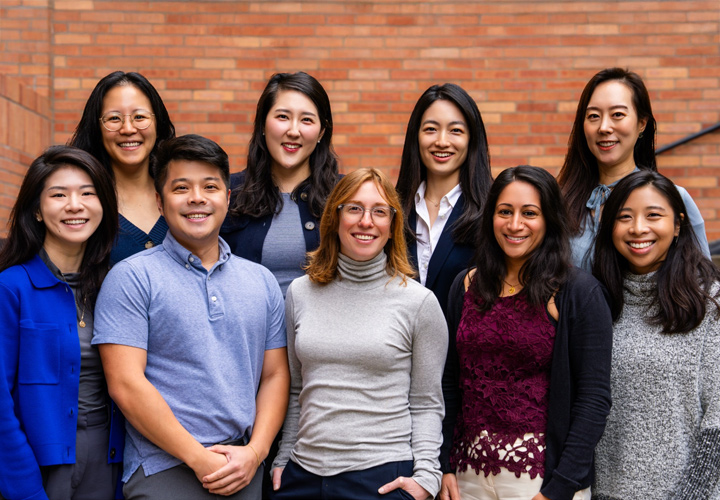 Top Row (l-r): Amy Indorf, Jina Yun, Grace Baek, Linda Yoon
Bottom Row (l-r): Ashley Chen, Mark Jao, Eve Segal, Beejal Ganti, Arianne Duong