
New York-Presbyterian Hospital
New York, NY
Pharmacoequity – the principle that all individuals should have access to high-quality medications regardless of race, ethnicity, or socioeconomic status – is increasingly recognized as a cornerstone of healthcare delivery.1 Chronic disease management in underserved urban populations presents persistent challenges, and ambulatory care pharmacy services have demonstrated significant benefits in medication optimization, cost-effectiveness, and patient-centered outcomes. 2-4 In response, NewYork-Presbyterian Hospital launched a comprehensive, enterprise-wide ambulatory care pharmacy program designed to standardize clinical services, enhance access through digitalization, and promote care for all.
Since its inception in 2018, the program has grown from a single collaborative drug therapy management (CDTM) agreement for diabetes to 17 agreements encompassing a wide range of conditions, such as hypertension, HIV prevention, oncology, and postpartum care. The team has grown from two to 15 clinical pharmacists, supported by pharmacy extenders, such as residents and ambulatory pharmacy technicians.
Key innovations include remote patient monitoring (RPM) programs for general and postpartum hypertension, which leverage EMR-integrated devices and pharmacist-led interventions to enhance care for under-resourced populations. A custom-built ambulatory care pharmacy dashboard tracks real-time clinical, operational, and financial metrics, enabling data-driven decision-making, closed-loop referrals, and service ownership. Professional development was prioritized through establishing a PGY-2 residency program and active preceptorship of students and residents.
The program has significantly improved patient access, clinical outcomes, and operational efficiency. Referrals increased from 216 in 2018 to 2,592 in 2024, while pharmacy visits rose from 887 to over 8,000 annually, with telehealth modalities comprising the majority since 2020. Among patients with diabetes referred to pharmacists, goal attainment (A1c < 8) improved from 38% at baseline to 44% after multiple visits, compared to 42% under usual care. For hypertension, pharmacist-managed patients saw goal attainment rise from 43% to 65%, with RPM programs playing a critical role. The postpartum RPM initiative enrolled 252 patients, bridged 56 to primary care, and facilitated timely interventions, including breastfeeding support and escalation for hypertensive crises. Despite low visit adherence rates reported for postpartum patients in the literature,5,6 80% of RPM-enrolled patients completed at least one pharmacist visit, reflecting improved access and patient engagement.
Population health initiatives have also flourished, with targeted efforts in medication adherence, annual wellness visits (AWVs), and medication therapy management (MTM). These programs utilized a layered learning model involving pharmacy extenders and have yielded measurable improvements in quality metrics and incentive payments. Financial strategies, including optimization of the 340B program, billing implementation, and collaboration with the internal specialty pharmacy, have further promoted pharmacoequity and sustainability.
The NewYork-Presbyterian Ambulatory Care Pharmacy Program’s success is attributed to standardized workflows, strategic use of technology, and robust stakeholder engagement. By integrating pharmacists into multidisciplinary teams and leveraging digital tools, the initiative has advanced pharmacoequity and demonstrated the transformative potential of ambulatory care pharmacy in addressing chronic disease and care for all patients.
References:
- Essien UR, Dusetzina S, Gellad W. A policy prescription for reducing health disparities –achieving pharmacoequity. JAMA 2021;326(18):1793-1794. doi:10.1001/jama.2021.17764
- Giambrone AE, Rodriguez-Lopez JS, Trinh-Shevrin C, et al. Hypertension prevalence in New York City adults: Unmasking undetected racial/ethnic variation, NYC HANES 2004. Ethnicity & Disease. 2016;26(3):339-344. doi:10.18865/ed.26.3.339.
- Dixon DL, Johnston K, Patterson J, et al. Cost-effectiveness of pharmacist prescribing for managing hypertension in the United States. JAMA Netw Open 2023;6(11):e2341408. doi: 10.1001/jamanetworkopen.2023.41408
- Li H, Radhakrishnan J. A pharmacist-physician collaborative care model in chronic kidney disease. J Clin Hypertens 2021;23(11):2026-2029. doi: 10.1111/jch.14372
- ACOG Committee Opinion No. 736: Optimizing Postpartum Care. Obstet Gynecol. 2018 May;131(5):e140-e150. doi: 10.1097/AOG.0000000000002633
- Bennett WL, Chang HY, Levine DM, Wang L, Neale D, Werner EF, et al. Utilization of primary and obstetric care after medically complicated pregnancies: an analysis of medical claims data. J Gen Intern Med 2014;29: 636 – 45. doi: 10.1007/s11606-013-2744-2
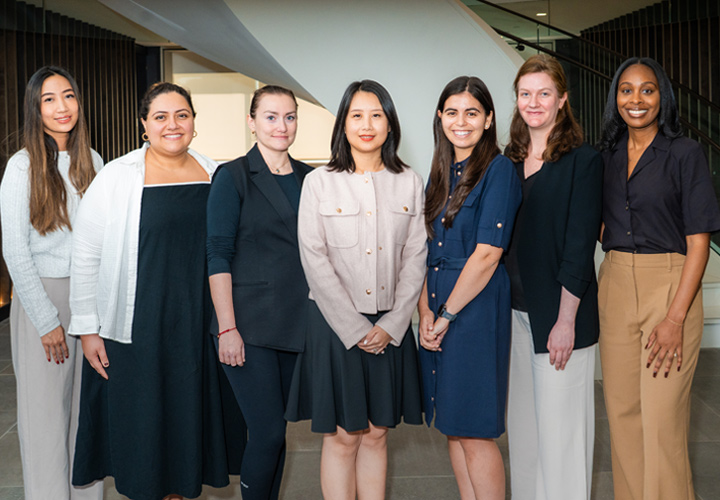 L-R: Celina Chow, Nadine Dandan, Yuliya Baratt, Hanlin Li, Dodi Zenilman, Amber Bradley, Shanice Coriolan
Not Pictured: Jim Thurston, Cindy Ippoliti