

Creating Custom AI Tools to Support Your Practice
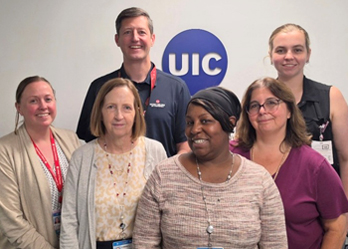
UI Health / UIC Retzky College of Pharmacy
Chicago, Illinois
- Submitted by: Adam Bursua, PharmD, MBA, CPPS
- Case Study Type: Workflow Optimization and Pharmacy Education
- Tool Type: Clinician or Internal-Facing, Internally Developed
- Published: July 2026
Case Overview:
Large language models have become widely available, but many pharmacists have difficulty incorporating them into routine practice. Generic AI interfaces often require users to repeatedly provide context about their role, preferred writing style, desired output, and organizational practices before producing useful results. This can limit efficiency and consistency.
To address this, our team developed a series of custom AI assistants designed around specific medication safety and professional use cases. Rather than requiring users to develop effective prompts for each interaction, each custom tool includes persistent instructions, predefined formatting, and organizational context tailored to a single task.
Examples include an SBAR Builder that transforms free-form narration into structured safety communications, a Project Brief Builder that creates standardized project guides for trainees, and a Clinical Timeline Builder that organizes narrated findings from multiple data sources into chronological event timelines. The goal is to reduce the effort required to organize and format information so pharmacists can devote more attention to analysis, communication, and decision-making.
Tool and Project Details:
The assistants were developed using commercially available large language models that support persistent instructions and custom workflows. Each assistant is designed around a single workflow and includes predefined formatting, writing style, and task-specific instructions. Users provide free-text narration, emails, meeting notes, bullet points, or other source content relevant to the task, and the assistant generates a structured draft. The assistants can also include custom conversation starters that guide users through common tasks, improving consistency and reducing the learning curve for new users.
Key Elements of Success:
The project focused on identifying recurring workflows that required pharmacists to repeatedly organize and communicate information. Rather than creating a general-purpose assistant, each assistant was intentionally designed to support a single workflow. Development was iterative, using real-world examples to refine instructions, formatting, and outputs until they consistently met user expectations. Pharmacist feedback continues to guide revisions as workflows evolve and additional use cases are identified.
Impact on Outcomes:
The assistants have reduced the time required to prepare documents used in medication safety and other pharmacy activities while improving consistency in organization and formatting. The SBAR Builder has helped members of the medication safety team communicate using a consistent structure, writing style, and organizational voice, resulting in more standardized safety communications across the team. The Project Brief Builder helps orient students and residents to project work, and the Clinical Timeline Builder assists investigators in organizing information from multiple data sources during event reviews. Formal evaluation is ongoing, but users report spending less time formatting information and more time focused on analysis and communication.
Budget & Resource Allocation:
The project was developed using commercially available AI platforms and did not require custom software development or integration with existing clinical systems. The primary investment was pharmacist time dedicated to workflow design, testing, and iterative refinement. Because the assistants were built around existing workflows, implementation required minimal changes to departmental processes and could be expanded incrementally as new needs were identified.
Lessons Learned:
Developing assistants around individual workflows produced more consistent results than relying on general AI conversations. Providing persistent instructions, predefined formatting, organizational context, and examples reduced the need for users to repeatedly explain their expectations. We also found that conversation starters lowered barriers to adoption by helping users begin common tasks. Human review remains essential, but AI can effectively reduce the burden of organizing information while preserving pharmacist oversight and clinical judgment.
Future Goals & Ongoing Monitoring:
Additional assistants are being developed for other medication safety and pharmacy workflows. Future work includes evaluating effects on efficiency, document quality, and user adoption while continuing to refine assistants through user feedback. We also plan to expand the library of workflow-specific assistants as new use cases are identified and to share our approach with other pharmacy departments interested in developing custom AI tools for their own practice.
Disclaimer
The information presented in this case study is provided for general informational purposes only and does not constitute legal, clinical, or professional advice. References to specific technologies, tools, or products are included solely to illustrate examples shared by the contributing organizations and do not imply endorsement by ASHP. ASHP makes no representations or warranties regarding the accuracy, completeness, or continued currency of the information presented. The information presented may contain errors, inaccuracies, inconsistencies and/or outdated information. Readers are encouraged to conduct their own due diligence and consult appropriate professionals before making decisions based on the information provided. ASHP disclaims any and all liability for damages or losses resulting from the use or reliance upon this content. ©2025- American Society of Health-System Pharmacists. All rights reserved.
ADVERTISEMENT
Member Only
Join ASHP today to get access to the full content